
Lamp Shade Replacement
Shade fitting, harps, finials, risers and replacement shades for every lamp style.
Vaughntero Co. has built its reputation on careful, unhurried work, and lamp Shade Replacement is where that shows most clearly. Below you will find a full explanation of the service, the components involved, and the practical guidance our technicians give customers every day.
What the Repair Typically Costs
Honest pricing starts with an honest diagnosis. Simple work such as a socket swap, a new plug, or a switch replacement sits at the low end of our range. Full rewiring, cluster sockets, multi-arm fixtures, and restoration work that involves polishing, lacquer removal, or structural repair take longer and price accordingly. We quote before we start and we do not add charges without a phone call first.
Customers often ask whether the repair is worth it. For most quality lamps the answer is clearly yes: a well-built base with good proportions and a shade that fits is worth more than an inexpensive replacement, and the repair typically costs a fraction of a comparable new piece. For heirloom lighting the calculation is not close at all, because the original cannot be replaced at any price.
See our pricing guide for typical ranges, or call (623) 979-1532 for a same-day estimate on your specific piece.
Step-by-Step: What Happens to Your Lamp
First, intake and documentation. Second, visual inspection of the exterior, base felt, cord entry, and shade fittings. Third, electrical testing of the cord, plug, switch, and socket with the lamp both energized and isolated. Fourth, a written quote with options where more than one path is reasonable.
Fifth, disassembly with hardware kept in labeled order. Sixth, the repair itself: rewiring, socket and switch replacement, mechanical tightening, thread repair, cleaning, and finish work as approved. Seventh, reassembly with correct polarity, proper strain relief, and a secured underwriters knot.
Eighth, burn-in testing. We run the lamp, cycle the switch through every position, and check for heat at the plug, socket, and any control. Ninth, final cleaning and shade fitting so the piece leaves looking cared for. Tenth, handover, with a plain-language explanation of what failed and what to watch for. Read the expanded version on our process page.
Repair Versus Replacement: An Honest Assessment
We do not repair lamps that should not be repaired, and we say so at intake. When a base is cast from pot metal that has crumbled, when a plastic body has become brittle throughout, or when the value of a mass-market lamp is genuinely below the cost of correcting it, we tell customers plainly and charge nothing for the opinion.
Far more often, the opposite is true. Solid brass, marble, hardwood, art glass, and quality ceramic bases are worth restoring and will outlast anything at a comparable retail price. Shades can be re-fitted. Finishes can be revived. Wiring is entirely renewable. The decorative shell of a good lamp is not the part that fails; the inexpensive electrical parts are, and those are replaceable indefinitely.
Our full comparison is in lamp repair vs replacement, written to help you make the call before you spend anything.
Antique and Vintage Considerations
Older lighting requires restraint. The correct outcome is a lamp that is electrically new inside and visually unchanged outside. That means preserving original patina rather than polishing it away, keeping original switches where they can be made safe, retaining maker marks and casting detail, and using reversible methods wherever possible so a future conservator has options.
We routinely handle brass and bronze bases, slag and stained glass shades, hand-painted ceramics, milk glass, mica and parchment shades, cast iron floor lamps, and mid-century pieces in walnut, teak, and enameled steel. Each material dictates a different cleaning method and a different adhesive or fastener strategy. Aggressive chemical cleaners and rotary polishing destroy value in minutes, which is why we test on hidden areas first.
Collectors and estate clients throughout Peoria and the wider Phoenix metro rely on Vaughntero Co. for exactly this discipline. Read more in our guide to caring for antique lamps.
Materials, Parts, and Standards We Use
Parts quality is where a repair either lasts a decade or fails in a season. We use UL-listed sockets, properly rated SPT-1 and SPT-2 cordage, correct-gauge wire for the load, and hardware that matches the finish and thread pitch of the original assembly. For antique and vintage pieces we source period-appropriate components: cloth-covered cord, brass-shell sockets in polished, antique, or satin finishes, and turn-knob or push-through switches that preserve the character of the original design.
Modern lamps benefit from modern components. Where a homeowner in Peoria wants smart-home compatibility, we can fit sockets and inline controls that behave predictably with LED lamps, avoiding the buzzing and ghost-glow that cheap dimmers cause. Where a fixture runs long hours in a commercial setting, we specify heavier hardware and heat-tolerant insulation.
We never reuse a component that shows heat discoloration, thread damage, or cracked insulation, even when it still functions on the bench. Restoring reliability means removing the parts that are on their way to failing, not only the part that already failed.
Working With Designers, Dealers, and Property Managers
Trade clients need predictability more than anything else: clear lead times, consistent finishes across multiple pieces, careful handling of items that belong to their own customers, and documentation they can pass along. Vaughntero Co. works to that standard. We provide itemized quotes, photograph pieces at intake, keep matched sets together, and can hold completed work until an installation date.
For property managers and hospitality clients, batching is the efficient path. We collect a group of fixtures, restore them on a coordinated schedule, and return them together with matched cords and hardware so a lobby or corridor reads as a single design intention instead of a patchwork of past repairs.
If you manage lighting inventory for a business anywhere in the West Valley, call (623) 979-1532 to discuss a maintenance schedule. Details are on our commercial lamp repair page.
Safety Considerations Every Owner Should Know
Lamps are the most commonly overlooked electrical hazard in a home. They are moved, tugged, wrapped around furniture legs, run behind rugs, and left plugged in for decades. Insulation hardens with heat and age, copper strands break inside a jacket that still looks intact, and the failure often shows up as intermittent flicker long before it becomes a burning smell.
The warning signs worth acting on immediately are simple: warmth at the plug or socket, a scorch mark or brown halo at the outlet, crackling when the switch is operated, a bulb that loosens on its own, visible cracking in the cord jacket, or a lamp that trips a breaker or GFCI. Any of these should take the lamp out of service until it is inspected.
This matters even more with Lamp Shade Replacement, where the components involved carry current continuously whenever the lamp is on. If you notice any of these signs in your Peoria home or business, unplug the lamp and call Vaughntero Co. at (623) 979-1532. Inspection is straightforward and inexpensive compared with the alternative.
LED, Dimmers, and Modern Bulb Compatibility
The shift to LED lighting solved an energy problem and created a compatibility problem. Legacy dimmers were designed for the steady resistive load of an incandescent filament. LED lamps draw a fraction of that load, and the mismatch produces flicker, buzzing, limited dimming range, or a faint glow when the lamp is supposedly off.
The fix is rarely the bulb alone. We replace the control with a trailing-edge dimmer rated for LED loads, verify the minimum load requirement, and confirm behavior across the full dial with the exact bulbs the customer intends to use. Where a lamp has multiple sockets, we make sure every bulb is the same type and driver family, since mixing brands is a common cause of uneven dimming.
Heat is the other consideration. LED assemblies fail from trapped heat in enclosed shades far more often than from age, so socket placement and shade ventilation are part of the repair. Our LED lamp repair guide covers this in detail.
Getting the Shade Right
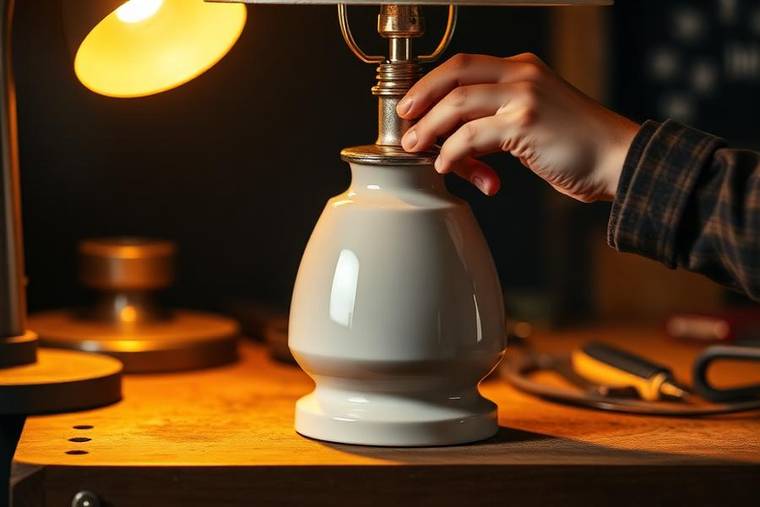
A shade is not only decorative. Its diameter, height and fitter type determine proportion, glare control and heat clearance around the bulb. A harp that is an inch too short changes the look of a lamp and can put a hot bulb far too close to the fabric.
We size harps, source spider, uno and clip fitters, supply finials and risers, and advise on shade materials from linen and silk to parchment, mica and glass. Bring the lamp so we can test the fit rather than guessing from measurements.
Talk to a Lamp Repair Specialist
Call (623) 979-1532 for free advice and a no-obligation estimate.